Thursday, 26 June 2014

Earth's Weather and Climate: Online Tools to Explore the Data

Data has become so commonplace in our day-to-day life that we seldom appreciate just how much information we collect on a daily basis. The challenge is not in compiling the data, however, but in how best to portray it in a way that allows us to distinguish between meaningful trends and insignificant noise. With the advent of the internet, scores of websites have come online that deals with this problem in new and inventive ways, using data previously inaccessible to the general public. Whereas before we could only visualise datasets through graphs or pictures, we can now interact with datasets, painting a much more thorough and informative picture.

However, another problem is knowing how to find these websites. This post will overview just some of the free and readily available tools that can be used to visualise climate change and weather statistics in an elegant and engaging way.

Thursday, 29 May 2014

India's Energy: How to Power 1.2 Billion People

India is a country so unique and huge that there are few facts or anecdotes can do justice to the sub-continents dizzying mix of culture, religion and languages. It is a country that simply must be explored, and one that I'm lucky enough to have just spent the past few months travelling across.
On an environmental front it is apparently a country of extremes; streets are dusty and dirty, stagnant water is often filled with malodorous waste and the city air is thick with smog. On the other side of the coin, however, it is a country in transition. Its green-energy growth is faster than almost anywhere else on Earth and, by raw numbers alone, the average Indian lives a far more sustainable life than the average westerner.

Tuesday, 21 January 2014

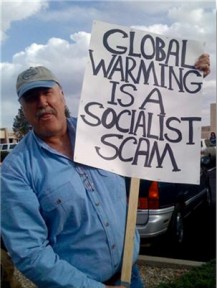
The Top 5 Most Influential Climate Change Deniers

When truth is inconvenient there will always be those that discourage it. Few people, for example, are foolish enough to refute the causative link between smoking and respiratory disease that has been demonstrated in medical science since the 1950s, and yet lobbyists still, to this day, fund pro-smoking policies to protect the tobacco industry.

The same is true of climate science. The threat of fossil fuel divestment and enforced cuts in greenhouse gas emissions gives a clear motive for various stakeholders to promote climate denial. A recent study examining US tax records has suggested that between 2003 and 2010 a total of 140 foundations made over $558 million of grants to promote human-caused climate change as a scientific mistake. Unfortunately, this likely represents just the tip of the iceberg with potential donors, keeping an eye on PR, reducing the amount of publicly traceable donations.

Sunday, 5 January 2014

The Untapped Potential of Geothermal Energy

You only have to see the steam billowing from Iceland's naturally heated 'Blue Lagoon' to realise the potential geothermal energy has to provide more than enough heat in even the coldest of places.

The 'Land of Fire and Ice' sits atop a plume of magma that lends itself perfectly to the exploitation of geothermal heat. This rather neglected renewable energy source has huge potential, and not just in Iceland. New technologies and growing demand makes geothermal power a possibility all across the world. At the moment, only 5% of global production potential is realised and the sector is growing by 10% each year.

Tuesday, 24 December 2013

Water Water Everywhere? The Future of our Water Supply

Worrying about water is nothing new. Finding reliable sources of water has long been a primary concern of our ancestors. Think how many major cities of the world surround rivers; the Nile, for example, literally acts as an artery of human civilisation (pictured).

Industrialisation and the subsequent explosion of population during the 1800s marked the start of major shortages, and by the turn of the 20th Century about 2% of people experienced 'chronic' water shortage. By 1960, this number had risen to 9% (280 million people) and by 2005 it affected a staggering 35% of the world's population (2.3 billion people).

In some areas, water is becoming as valued as oil and some predict it to be a major source of conflict and war in the 21st Century and beyond. Unfortunately, things may be about to get worse. Recently, research has indicated that climate change will seriously impact water availability and this, when coupled with our rapidly rising population, makes water supply one of the most serious challenges facing human development. 

Saturday, 14 December 2013

The Rise of Renewables - The Stats and Facts of Renewable Energy

A society fuelled solely by renewable energy must surely one of the ultimate goals of humanity. Whether you subscribe to anthropogenic climate change or not, no one can deny that fossil fuels will, eventually, run out. You can argue that finding new reserves, using new technologies, the rise of fracking, etc. etc. will ‘save’ us. But ultimately these options are, at best, a short term solution if millions – billions - of humans want to live the modern way for more than the next few centuries.

We are, however, on the right track. Each year a network of renewable and policy stakeholders, called REN21 (Renewable Energy Policy Network for the 21st Century), publish a report on the state of renewable investment and policy in the world. It’s an interesting and optimistic read.

Here are some of the most interesting facts of their latest report.

Sunday, 8 December 2013

Frack from Fiction - The Pros and Cons of Fracking

It seems that everybody is talking about fracking recently. It has been the cause of many polarised debates and is a hot topic amongst environmentalists and energy companies alike. Yet it is nothing new; breaking rocks to extract gas was first experimented with in the late 1940s and the method used today has been a serious source of gas since the late 1990s.

With the cost of fracking declining and the demand for cheap natural gas increasing, it looks as if the argument is here to stay. The number of new fracking sites have now outstripped the building of new conventional rigs and in excess of 200,000km3 of recoverable shale gas is reportedly trapped under our feet. 

It's probably time, therefore, to take an impartial look at the facts of fracking.